



Hi Florensia!
for players who have been playing Florensia for a long time, there have always been discussions about whether elemental resistances do anything. With this post, I’d like to clear up some of the myths surrounding that topic.
Before we dive deeper into how elemental resistances work, I’d like to point out a few things first:
To explain the effects of the elemental system, we first need to cover some basic concepts.
You may have noticed that skills in your skill menu (K) include an additional line indicating their element.
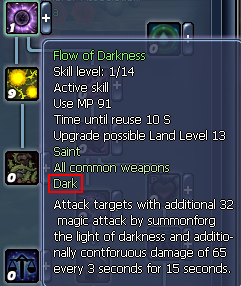
The following elements exist:
Physical and Poison skills use your physical hit rate, while Fire, Ice, Lightning, Holy, and Dark skills use your magic hit rate.
Your character also has elemental resistances, which can be found in your character information window under “Resistance”.
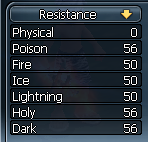
Currently, there are no items that directly influence these stats. At the moment, elemental resistances can only be increased by allocating status points as follows:
In addition to physical and magical defense, monsters also have elemental resistances.
When it comes to skills, Florensia internally classifies them into three categories:
However, not every skill that applies a debuff is classified as a Curse Skill. For example, Phantom Grief from Noble is classified as a Curse Skill, while Flow of Darkness from Saint is not. This distinction will become important later.
Internally, each skill also has two values assigned to it that are used during hit calculations:
Now that the groundwork is covered, let’s take a look at how Florensia determines whether a skill hits and how elemental resistances affect that calculation.
To begin with, any skill with a hit value of 100 can never miss. One example is Lightning Shock from Noble. Those skip the whole calculation.
For all other skills, the following calculations are performed:
The game first runs its internal base hit rate formula. This calculation uses:
The formula also includes diminishing returns for both hit rate and avoid values.
Depending on whether the caster is a player or a monster, additional modifiers are applied:
If the caster is a player and more than 4 levels below the target, a penalty of -10% per level difference is applied, capped at -50%.
If a lower-level monster attacks you, a modifier of -3% per level difference is applied, capped at -50%.
If a higher-level monster attacks you, a modifier of +2% per level difference is applied, capped at +20%.
After all calculations are completed, the game arrives at a final hit value between 0 and 100. The game then rolls a dice from 0 to 100. If the final hit value is higher than the roll, the skill successfully hits.
Skill:
Attacker:
Defender:
After Step 1, we end up with a value of ~86.
Since we’re higher level than the target, no penalty is applied in step 2.
In step 3, we add our accuracy modifier value of +10, which bumps us up to 96.
Because Light Transition is a damage skill, no elemental resistances are considered.
In the end, we have a 96% chance to hit the target.
Note: While the hit calculation did not include the negative holy resistances, the formula to calculate the damage dealt will include the resistance value and increase the damage.
Example 2:
Skill:
Attacker:
Defender:
Following step 1 to 3, we end up with a value of 100.
Now, since Phantom Grief is classified as a curse skill, elemental resistances (here dark) are added to the calculation.
After including the 900 dark resistance Steel Guard has, we end up with a value of 11.
We therefore have a 11% chance to hit Steel Guard with Phantom Grief.
As mentioned at the beginning of this post, this is the current implementation of the system. We understand that none of this is really intuitive and might also be misleading at some points (why is Flow of Darkness classified as a Damage Skill and therefore doesn't respect dark resistances?).
However, we hope this breakdown helped clarify how the system currently works and cleared up some long-standing misconceptions surrounding elemental resistances.
Greetings
Jeremy
